Please note that due to the heavy fluctuations in the gold market, sometimes we may not be able to honour the prices listed on the website.

The Secret Language of Gold Jewellery: Decoding Hallmarks and Purity Stamps in Australia

You’re clearing out a late relative’s jewellery box and find three pieces: a 916 chain, a 375 signet ring, and a bangle stamped “18K HGE.” Three stamps, three wildly different values, and one of them is worth almost nothing.

Australia has no government hallmarking system, so decoding gold hallmarks Australia-wide relies on your own eye, not a government tester, and that is the difference between a fair price and a bad one. This hallmark guide breaks down exactly what gold jewellery stamps mean, and what each one is really worth.

Table of Contents

What is a Gold Hallmark?

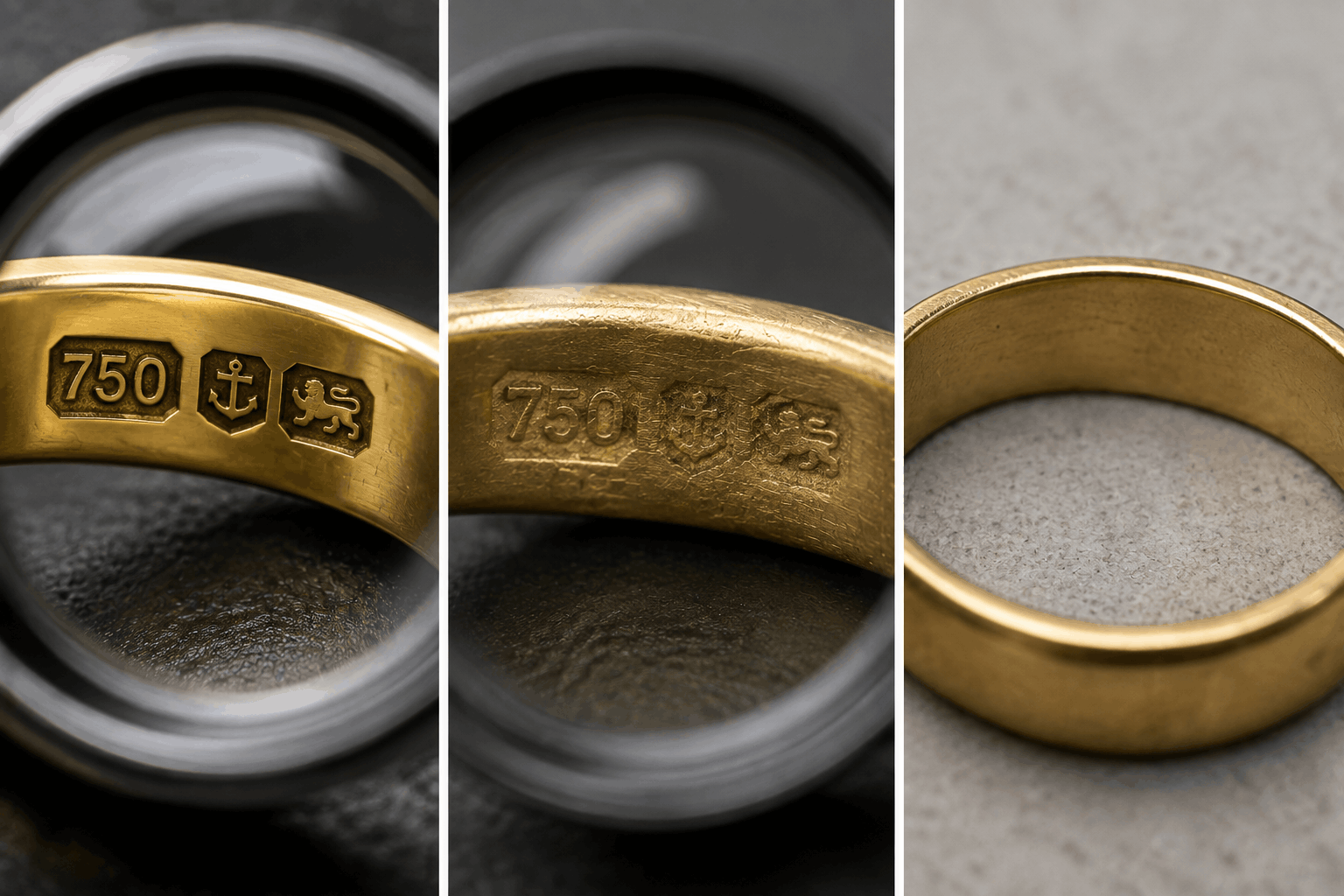
A gold hallmark is a small stamp showing the metal’s purity, and sometimes its maker and origin.

A true hallmark means an independent assay office tested the metal and confirmed what it claims to be. Australia has no government assay offices and no compulsory hallmarking law, so most marks on jewellery here are applied by the manufacturer itself, not by an independent tester. That makes most Australian gold stamps a claim, not a certificate.

A ring stamped 750 by its maker might genuinely be 18 carat. It might not be, and there’s no legal body checking either way. This is why professional testing decides the payout on your gold, not the stamp alone.

Gold Purity Chart: What Every Number Means

The number on your gold is millesimal fineness: parts of pure gold per 1,000, simply another way of expressing karat vs fineness, the same idea measured out of 24 parts instead of 1,000.
Stamp Karat Pure gold Commonly seen on
999 / 999.9 24ct 99.9% Bullion bars and coins
916 22ct 91.6% Indian, Middle Eastern, Singaporean jewellery
875 21ct 87.5% Gulf states, Turkey
750 18ct 75.0% European and luxury fine jewellery
625 15ct 62.5% British, pre-1932, indicates an antique
585 14ct 58.5% US and European rings, everyday fine jewellery
417 10ct 41.7% US-made jewellery
375 9ct 37.5% The Australian and British standard

375 is Australia’s most common gold stamp, and it’s genuine gold, just at a lower purity than you’ll see elsewhere.

Australian Gold Marks: the Kangaroo and the Lost Melbourne Hallmarks

Australia has one voluntary marking scheme with real teeth. The Gold and Silversmiths Guild of Australia, formed in 1988, runs the only comprehensive precious metal marking scheme in the country. Its mark is a kangaroo head in profile, set inside a diamond or circle border. Melbourne had its own hallmarking system once. In 1889, the Manufacturing Jewellers’ Association of Victoria introduced a pictorial scheme: a sheaf of wheat for 9ct, a pick and shovel for 12ct, a hung sheep for 15ct, and a sailing ship for 18ct. It spread to other states before fading out in the 1920s.

Foreign Stamps: What Imported and Inherited Gold Tells You

Most gold sitting in Australian jewellery boxes was made overseas, and every country marks it differently.

Gold hallmarks by country of origin
OriginWhat you’ll seeWhat to check
IndiaBIS triangle logo + 916 or 750 + a 6-character HUID codeVerify the HUID is free in the BIS CARE app, it works from Australia
United KingdomSponsor’s mark, fineness, assay office town mark, date letterLeopard’s head = London, anchor = Birmingham, rose = Sheffield
EuropeMillesimal number, often a Common Control MarkItaly adds a numeric maker’s mark plus a province code
Middle East / Türkiye875, 916 or 999High purity, usually little or no maker’s mark
China / Hong KongAu999, 990, or the characters 足金“Chuk kam” means near-pure gold

Not Sure What Your Gold Jewellery Is Really Worth?

Leverage a free XRF purity test and a written quote on the spot, done in front of you.

Bring a competitor’s quote too, we’re happy to compare it…

The Stamps that Mean it's not Solid Gold

Some gold plated stamps look like purity marks but only describe a coating over a base metal.

MarkMeaningMelt value
GP / GEPGold plated or electroplated, a very thin layerNegligible
HGEHeavy gold electroplate, a thicker coatingNegligible
RGPRolled gold plate, bonded but below the gold-filled thresholdVery low
GF (e.g. 1/20 12K GF)Gold filled, gold is at least 5% of total weightLow but real
925 + gold colourVermeil: gold over sterling silverSilver value

On “18K HGE,” the 18K describes the coating, not the item.

Fake Stamps, Worn Stamps, and No Stamp at All

Fake Stamps, Worn Stamps

Spotting a fake gold hallmark comes down to a few warning signs, worth checking before you trust any stamp:

  • Blurred or shallow stamps
  • Non-standard fineness numbers that don’t match any known standard
  • A carat mark with no maker’s mark on a modern piece
  • A clasp or resized shank that’s a different colour or hardness to the rest of the piece
  • A piece that feels too light for its size
  • A “bullion” bar with no serial number or assay card

Gold with no hallmark isn’t automatically fake. Handmade, pre-1950s, resized and worn pieces are often unstamped for entirely legitimate reasons.

Testing methods vary too. XRF gold testing in Melbourne dealerships is the industry standard: non-destructive, with a full alloy breakdown in seconds. Acid and streak tests work but can mark the piece. Electronic testers are useful for screening only. Specific gravity testing catches core-filled fakes that pass a surface scan.

What Your Hallmark is Actually Worth

What Your Hallmark is Actually Worth

What Hallmarks Mean for Gold Investors

Under Australian GST law, gold only qualifies as GST-free “precious metal” if it’s at least 99.5% fine and in investment form: a bar, wafer or coin bearing a mark accepted as identifying and guaranteeing its fineness and quality. The stamp itself is part of the legal test for GST-free status.

For bars, look for the refiner’s name, weight, fineness, serial number and assay card. Keep every record and assay card for capital gains purposes. Our full guide to gold bullion tax in Australia covers GST and CGT in detail.

This is general information only and not tax or financial advice. Speak to a registered tax agent.

Frequently Asked Questions

Does gold have to be hallmarked in Australia?

No. Australia has no compulsory hallmarking law and no government assay offices. Marking is voluntary and largely self-applied by the manufacturer.

375 means 37.5% pure gold, or 9 carat, Australia’s most common gold standard. It’s genuine gold with real resale value.

Yes. 916 means 91.6% pure gold, which equals 22 carat. It’s the standard for Indian and Middle Eastern jewellery.

9ct gold is 37.5% pure gold, Australia’s most common standard, stamped 375. 18ct gold is 75% pure gold, stamped 750, and typically used in European and luxury fine jewellery. At the same weight, an 18ct piece contains double the pure gold of a 9ct piece, so it carries roughly double the melt value, though it’s also softer and more prone to scratching than 9ct.

Yes. Handmade, antique, resized and imported pieces are often unmarked. XRF testing confirms purity without damaging the item.

Before Selling Gold Jewellery in Melbourne

In Australia, a hallmark is a claim, not a certificate. Read correctly, though, it still tells you where a piece came from and what it’s worth. Purity, weight and the day’s gold price set the final number, not the stamp alone. Professional testing removes uncertainty before accepting an offer. This hallmark guide’s practical takeaway is simple: get any piece tested before you sell gold across Melbourne. 

If you’re ready to sell gold, we’re here to help. Bring any piece in for a free XRF test and written quote on the spot, and bring a competitor’s quote too, we’re happy to compare it.

Sharma Bullion, your local cash for gold Melbourne destination: Suite 808A, Level 8, 125 Swanston St, Melbourne CBD. Call 0488 786 680.

Buy, Sell or Get Expert Advice on Gold Bullion in Melbourne

Gold Buyers Sharma provides certified gold products, transparent pricing and trusted guidance for investors across Melbourne.

Get a Free Quote Now