Please note that due to the heavy fluctuations in the gold market, sometimes we may not be able to honour the prices listed on the website.
GOLD $7,264.59/oz
SILVER $122.05/oz
Many Melbourne jewellery owners and small investors monitor the gold price in Melbourne before making a decision to sell. Some notice steady upward movement. Others see sudden dips and feel uncertain. Furthermore, the silver price in Melbourne can appear even more volatile, moving sharply over short periods.
These movements are not random. Gold and silver market fluctuations follow economic cycles, currency changes and investor behaviour patterns. When sellers understand what drives these changes, they can approach the market calmly instead of reacting emotionally.
This guide explains why gold and silver prices fluctuate, how to interpret market graphs correctly, and what these movements mean for Melbourne sellers who want to act strategically.
Gold and silver prices adjust constantly because markets respond to new information every day. Inflation updates, central bank decisions, political events, and shifts in global demand all influence price movement.
Investors often treat gold as a store of value during economic uncertainty. When confidence in financial markets weakens, demand for gold typically rises. Silver behaves differently because it serves both as an investment asset and an industrial metal. Manufacturing demand directly affects silver, which often increases silver market volatility compared to gold.
Fluctuations reflect market reactions, not instability. Movement shows how quickly supply and demand adjust to changing conditions.
Several consistent forces influence gold market volatility and silver market volatility. These drivers operate globally but directly affect local pricing.
Key drivers include:
When inflation increases, investors often shift capital into gold to preserve purchasing power. When interest rates rise, some investors move funds into yield-generating assets, temporarily reducing demand for gold. These reactions create visible gold market fluctuation.
Because gold trades internationally in US dollars, currency strength plays a crucial role. Exchange rate changes influence how global prices translate into Australian pricing.
Use Gold Buyer Sharma’s live gold price Melbourne tracker to monitor real-time trends and make informed selling decisions.
Gold and silver do not move identically, even when influenced by the same economic events.
Gold primarily reflects financial demand and long-term wealth preservation. Its movement often aligns with broader economic cycles. Silver carries additional industrial exposure. Solar panels, electronics, and manufacturing sectors consume significant quantities of silver.
This dual role increases silver market fluctuation, especially during periods of economic expansion or slowdown. Silver can rise rapidly during periods of industrial growth and fall sharply during periods of contraction.
For Melbourne sellers, this difference means silver may present shorter opportunity windows, while gold often shows steadier movement over time.
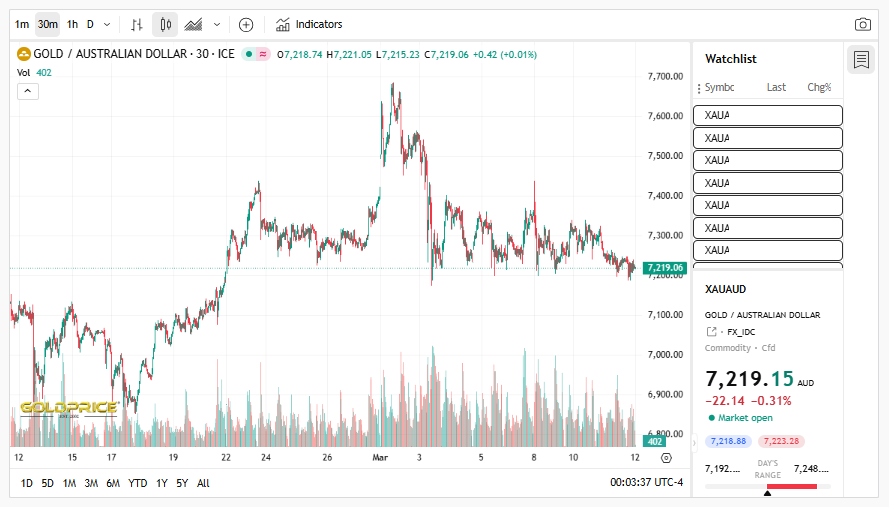
Note: This chart reflects gold and silver prices up to 12ᵗʰ March 2026.Prices change frequently, kindly view the latest updates on our live gold and silver price tracker.
A price graph shows more than daily movement. It reveals patterns over time. Short-term spikes often reflect immediate reactions to economic announcements or global events. These movements can reverse within days.
Long-term trends tell a different story. Sustained inflation, currency weakness, or prolonged uncertainty can create a gradual upward movement in gold and silver prices. Gold often demonstrates steadier long-term growth, while silver may show sharper short-term peaks and pullbacks within that broader trend. Track these movements using our live gold and silver price tracker for the latest market trends.
Understanding this distinction prevents emotional decisions. A temporary dip does not always indicate long-term decline. A sudden spike does not guarantee continued growth. Strategic sellers focus on trend direction rather than isolated daily movements.
Local payouts depend on more than international spot prices. Buyers calculate offers using several components that influence the gold price and silver price in Melbourne.
These include:
If global prices rise while the Australian dollar weakens, Melbourne sellers may receive stronger local offers. If the Australian dollar strengthens, local prices may soften despite steady global demand.
Understanding this currency effect helps sellers interpret pricing more accurately.
Volatility can create opportunity when interpreted correctly. Periods of gold market volatility often coincide with economic uncertainty, which can drive prices higher. Silver market fluctuation may produce shorter, sharper opportunity windows.
Experienced sellers avoid reacting to headlines. They monitor trends over several days or weeks and seek professional valuation during upward cycles.
Strategic sellers:
This measured approach transforms volatility from risk into advantage.
Visit Gold Buyer Sharma for transparent valuations based on real-time gold and silver prices.
Economic cycles, currency movements, investor behaviour, and global demand patterns drive gold and silver market fluctuations. Inflation, interest rates, exchange rates, and industrial consumption all drive gold market volatility and silver market volatility.
These forces shape the gold and silver prices in Melbourne everyday.
When Melbourne jewellery owners and small investors understand the structure behind price movement, they gain clarity. Instead of reacting emotionally to daily changes, they monitor trends and act strategically.
With live tracking tools and professional valuation locally, market fluctuation becomes a structured opportunity rather than a source of uncertainty.